
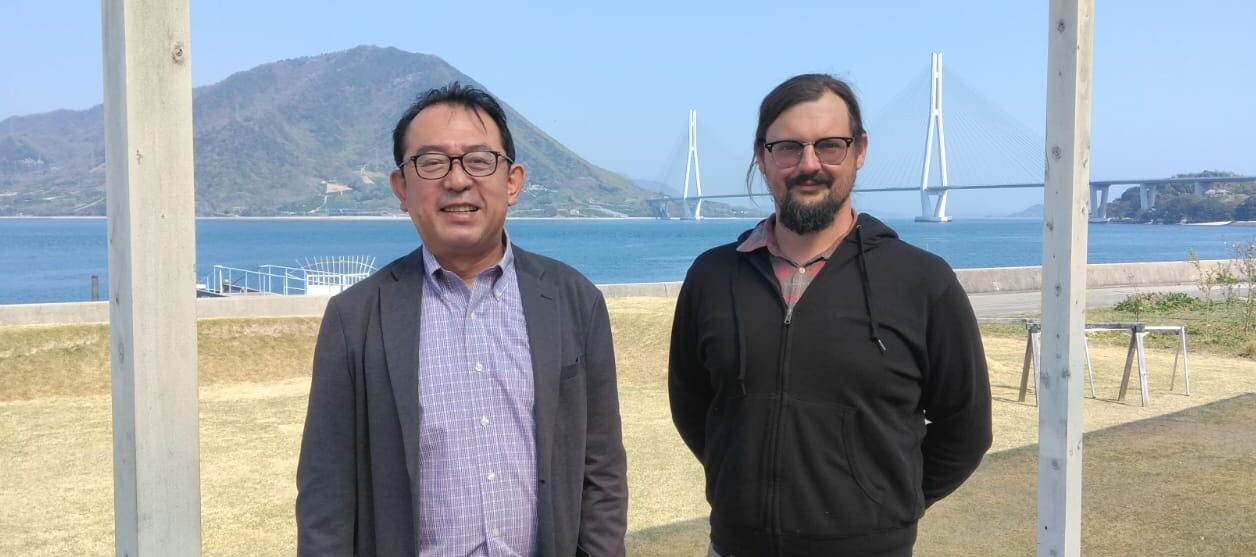
Happy new year! If you’ve been following our story for the past three years, you know that we regularly reference the ‘team of professionals’ we’ve been working with since the day we arrived in Japan. This team is made up of our Immigration Lawyer, Business Consultant, and Accountant. Without the guidance and insight of these three professionals, everything we’ve accomplished would have been much more difficult, or impossible, to achieve on our own. Today I’d like to highlight an achievement earned by our business consultant: Mizobuchi-sensei.
We were first introduced to Mizobuchi-san through Imabari city. During our initial in-person meeting with Imabari to discuss the possibility of applying for the Startup visa program, they recommended we bring Mizobuchi-san on board. We’ve very thankful for the introduction, as he has continued to support our business in many ways over the past three years: Mizobuchi-san was essential in the creation of our Startup visa application and initial business plan, as well as providing his translation services and guidance throughout the Startup program time period. Since then, he continues to closely monitor our business growth in order to forecast updates to our business plan, up to ten years into the future. This is an important piece of each Business Manager visa renewal application, and also important for our own planning, budget, and strategy. He was also instrumental in Benton Homestead receiving the small business subsidy, for the Guesthouse and Retro Shop renovation work to be completed this winter. He’s always available if we have questions unrelated to business, or if we need guidance culturally. I couldn’t imagine the last three years without him!
Mizobuchi-san is a member of JF-CMCA: Japan Federation of Certified Management Consultants’ Association. This is an umbrella organization overseeing the 47 prefectural-level Associations of Certified Management Consultants throughout Japan, operating under the jurisdiction of METI: Ministry of Economy, Trade and Industry.
JF-CMCA holds an annual symposium, and presents awards for excellence in several areas related to consulting. Last year, Mizobuchi-san submitted a Case Study to detail his role in supporting our fledgeling business, Benton Homestead. Mizobuchi-san received the President’s Award! He was invited to present the case study at the annual symposium in Tokyo. It’s uncertain, but we suspect this is the first time in the history of JF-CMCA that the President’s Award has been received by a consultant guiding a foreign-owned and operated business.
Now that the paper has been published, we can share this exciting news! The link takes you to the online publication, in Japanese. We will have an English translation to follow. I’m sorry that I couldn’t bring the graphics and tables over from the publication, but as you read in English, you’re welcome to flip over to the Japanese publication.


Here’s our YouTube video reading through Mizobuchi-sensei’s award-winning case study ⌄
English Translation:
Announcement of the award-winning paper at the 2025 “Small and Medium-sized Enterprise Management Consulting Symposium”
[Session 1: Japan Association of Management Consulting President’s Award]
Building inbound businesses by foreigners utilizing local resources
―Examples of startup support for foreigners utilizing management self-propulsion tools―
Hiroshi Mizobuchi
Introduction
This article introduces a case study in which a foreigner started a business targeting inbound tourists by utilizing old houses and abandoned farmland in rural areas, with support from a small business consultant. With the number of inbound tourists increasing year by year, there is a growing need to provide services that meet the needs of foreign customers and to plan and implement measures to attract them. In rural areas facing population decline and aging, foreign-led inbound tourism businesses utilizing vacant houses and abandoned farmland are considered effective for revitalizing the local economy and creating new value. However, foreign entrepreneurs face numerous challenges, including cultural and language barriers, as well as the requirement to develop and execute business plans for visa purposes. Furthermore, in recent years, there has been an increase in foreigners attempting to obtain “management visas” based on business plans lacking practicality, as seen in various media reports. This has led to a growing need for the development and implementation of more feasible business plans. This article introduces a case study of the establishment of an inbound-focused business by foreigners in Imabari City, Ehime Prefecture, and the accompanying support provided.
Background to the Support
(1) About Evan and Dani Benton
The main characters in this case study are Evan and Dani Benton, a couple from Oregon, USA. They ran a guesthouse, beekeeping business, and photography business in the US. Seeking a milder climate, they decided to start a guesthouse and beekeeping business on Ōmishima Island in Imabari City, Ehime Prefecture, where they had previously visited. The Imabari City Startup Visa Program (described below) and the fact that the Seto Inland Sea Shimanami Kaido (hereinafter “Shimanami Kaido”) is known as a cycling mecca among foreigners were also reasons for choosing Ōmishima Island. The couple arrived in Japan in January 2023 and applied for the startup visa in Imabari City. Imabari City consulted with the Ehime Prefecture Small and Medium Enterprise Diagnosis Association regarding the couple’s application, and I, who have overseas business experience, was assigned to support them.
(2) Overview of the Startup Visa Program
The Startup Visa Program is a system that allows foreigners to obtain a “Business Management Visa” under more relaxed conditions than usual when starting a business in Japan. Under this program, local governments can grant residence status to foreigners who wish to start a business in Japan, even during the preparatory stage, if they meet the requirements. Entry into Japan is permitted if a business plan that meets the criteria is submitted within six months. After six months, the local government will review the progress of the business plan and make a decision on renewal. Following renewal, the visa will be converted to a “Business Management Visa,” making the development and achievement of a valid business plan is the critical conditions for visa acquisition and renewal (this system is scheduled to be implemented nationwide starting in fiscal year 2025, with the validity period extended from six months to two years).
(3) About Ōmishima Island
Ōmishima Island is a part of the Geiyo Islands, which belong to Imabari City in Ehime Prefecture, and is connected to Shikoku and Honsyu by the Shimanami Kaido. In recent years, the population has halved due to aging and population outflow, with approximately 5,000 people currently residing there. On the other hand, access from Honsyu is convenient, and the island attracts many overseas tourists due to its well-developed facilities for cyclists. However, there is a shortage of workers to meet the increasing demand for tourism, and the inability to provide adequate services is an urgent issue.
Support Details
In providing support, we work together with other professionals (administrative scriveners, tax accountants) to (1) form teams, (2) provide support for obtaining startup visas, (3) provide support for start-up preparations, and (4) provide ongoing support after the business has started. The details of our support are explained below for each step.
(1) Forming team
Foreigners starting a business in a local area must go through many procedures, such as obtaining visas, registering as residents or corporations, and obtaining permits for each business. Even after starting a business, they must overcome the hurdle of regularly renewing their visas. In addition, they are required to comply with laws and regulations, such as filing tax returns and various administrative applications, despite language barriers. Therefore, in order to provide comprehensive support, I consulted with administrative scrivener and tax accountant, and the author acted as a liaison to form a team and establish a support system to accompany them before and after starting their business.
(2) Support for obtaining a startup visa
First, we began creating the visa application forms specified by Imabari City, such as resumes, as well as business plans and schedules (monthly activity plans for six months after approval). We started by conducting a macro survey and analysis of the local economy, the private lodging and beekeeping industries, and inbound demand, and shared that information with the couple. In addition, we created tools such as market research forms and profit and loss calculation forms.
The market survey form included market information, target customers, sales channels, and advertising strategies, which were used to develop and formulate marketing strategies. Honey will be sold through consignment sales at the two roadside stations on the island and through the company’s website. Since attracting guests to the guesthouse was the biggest challenge, we promoted activities to expand local awareness by streaming videos and other social media content overseas showcasing the renovation of traditional houses and abandoned farmland, as well as participating in local events such as festivals.
A profit and loss calculation form was created that allows the couple to manage their own finances by inputting prices and quantities to calculate profits and losses, investments, and depreciation. Subsequently, the content was reviewed in light of the market research results to enhance the couple’s understanding of market trends and business objectives. The profit and loss calculation form is still used for monthly performance management and business outlook management.
After completing the visa application documents, I attended meetings with Imabari City officials to explain the details and accompany them on site visits. I provided support by explaining the contents of the business plan and schedule and responding to questions. As a result, the application was accepted by the city in April 2023, and an administrative scrivener subsequently applied for and was granted a startup visa.
(3) Start-up preparation support
In order to renew the visa, it was necessary to reliably execute the plans listed in the schedule within a short period of six months. Therefore, team meetings were held every other week, including the couple, to confirm the progress of the private lodging business, beekeeping business, and various professional duties, and to discuss and implement solutions to issues.
One example of this is the discussion of executive compensation and rent amounts conducted with the tax accountant and administrative scrivener. The guesthouse property was purchased by the couple and leased to a corporation, with the corporation paying the couple a combination of executive compensation and rent.
However, it was necessary to determine an appropriate amount from the perspectives of business management, taxation, and visa application. Therefore, we consulted with a tax accountant and administrative scrivener to determine a reasonable amount for executive compensation and rent. Additionally, a prefectural license is required for the guesthouse business. However, since the administrative scrivener handling visa matters resides outside Ehime prefecture (in Fukuoka), we worked with a local administrative scrivener to confirm the requirements. They met each of the conditions specified in the Fire Services Act and the Guesthouse Act (such as installing fire alarm devices, responding to fire department inspections, and managing guest stay records), and successfully opened the guesthouse as planned in November. Advertising for the opening was carried out in line with the initial marketing strategy, with weekly YouTube videos on the restoration of private houses and information provision via social media. As a result, the business was featured on TV programs in the US and UK after being introduced by a famous foreign YouTuber living in Japan, which led to an increase in guests using the guesthouse. Additionally, monthly YouTube live chat events were held to share experiences after moving to Japan, attracting many viewers each time. Among the participants, some followers requested the couple’s support for initial research to open a guesthouse in Japan, leading to unexpected consulting income for the couple. As part of other PR activities aimed at the domestic market, I wrote an article introducing the couple’s business and submitted it to the prefectural government press club. The article was picked up by a local newspaper, which helped raise awareness of the business both within and outside the prefecture. Foreign entrepreneurs are still rare in rural areas, and since then, they have received a steady stream of requests for interviews from the domestic media. The couple is also scheduled to be featured on an NHK program in August.
(4) Post-launch support
After the launch of the private lodging business (November 2023), I provided support in the form of advertising and publicity, such as accompanying the owner during interviews with local newspapers. At the same time, I adviced on product planning and pricing in preparation for the launch of honey sales (launched in April 2024).
Performance in the first year (through July 2024) fell short of the business plan, which could have made visa renewal difficult. Therefore, I analyzed the financial results to identify the factors contributing to the decline, and created a revised business plan that clearly outlined countermeasures and expected improvements. This fiscal year, which marks the second year of operations, we created a tool to monitor KPIs such as monthly sales figures, honey production and sales, and guest house revenue on a daily basis. I have been monitoring the progress of the business in real time with the couple and providing advice. As a result, the fiscal year-end results can be expected to show a profit. For the upcoming fiscal year, we plan to renovate the warehouse on the premises to launch a retail business. To secure funding, we have begun applying for the Small and Medium-sized Business Sustainability Subsidy (Startup Type) and seeking loans from local banks.
Conclusion/Future Prospects
The number of foreign entrepreneurs utilizing management visas has increased significantly in recent years. However, due to issues such as inappropriate visa usage by some foreigners primarily in major metropolitan areas and free-riding on public infrastructure, system revisions centered on stricter approval criteria have been implemented (October 16, 2025). This change is expected to temporarily stabilize the number of foreign entrepreneurs using management visas and startup visas.
Meanwhile, in rural areas grappling with aging populations and declining residents, foreign entrepreneurs are expected to continue increasing. This is driven by hopes that capturing inbound tourist demand will enhance diversity and generate new economic vitality. Around the couple, restaurants and guesthouses opened by domestic and international migrants have proliferated over the past two years, creating new demand for foreign entrepreneur support services.
This case study confirmed that support from a professional services team centered around a Small and Medium Enterprise Management Consultant is effective for foreign entrepreneurship. Furthermore, collaborating with other professionals provided new insights unattainable through individual efforts. Additionally, the couple’s sales channel development activities utilizing YouTube livestreams and live chat events are methods we intend to promote as effective approaches for supporting domestic businesses as well.
Finally, supporting foreign entrepreneurs begins with developing an effective business plan. By working alongside the entrepreneur to continuously improve operations through the PDCA cycle, this field allows Small and Medium Enterprise Management Consultants to fully demonstrate their expertise, helping entrepreneurs surpass their primary goal of visa renewal. Fortunately, advancements in translation and interpretation apps are making multilingual communication increasingly accessible, and I myself have greatly benefited from such tools. I sincerely hope this case study contributes to supporting more foreign entrepreneurs.
Thank you , Mizobuchi-san, for all of your support and friendship the past three years! We look forward to working together for many more years to come.
Thanks for reading,
ダニとエバン ベントン


 日本語
日本語  English